

There’s a quiet truth in industrial marketing that doesn’t get talked about enough: Most companies don’t fail at marketing because they hired the wrong industrial agency. They fail because they never fully leverage the one they hired.
On paper, the relationship looks right – the B2B agency is capable, the internal team is aligned and the work gets done. But somewhere along the way, the partnership gets reduced to a series of requests, reviews and revisions. The agency becomes a vendor when what you need is something far more valuable: a strategic partner capable of accelerating growth.
“At DeanHouston, I’ve seen both sides. I’ve worked with organizations that unlock extraordinary value from our relationship, and others that unintentionally limit what’s possible,” said Cody Schindler, Senior Marketing Manager at DeanHouston. “The difference isn’t budget; it’s not even talent. It comes down to how willing they are to treat us as a true extension of their team – sharing context, embracing collaboration and trusting the process beyond the immediate ask.”
That shift, from vendor to partner, is where everything changes.
Here are 5 tips to make it happen.
1. Start by Sharing Business Objectives
Most marketing agency relationships begin with a request.
“We want a brochure.”
“Can you build a campaign?”
“We need more leads.”
Here’s the problem: those requests might be valid, but they’re not strategic.
The real opportunity lies deeper, beyond one-off projects that fill an immediate need. Growth happens when your industrial agency understands the business objectives behind the ask.
Are you trying to enter a new market? Shorten the sales cycle? Improve spec-in rates? Reposition after an acquisition? Those are the conversations that unlock better work and better outcomes.
Sharing your company’s goals is the first step to building a true partnership with your B2B agency. Once an agency truly gets what you want to achieve, they’re no longer just executing. They become a key part of your team. They can challenge assumptions, identify more effective approaches and build solutions that go beyond what was originally requested.
If your agency isn’t pushing past the task, it’s worth asking whether they have the context they need to deliver more.
2. Give Them Access, Not Just Assignments
 Expertise only goes so far without context.
You may have hired your industrial marketing agency for their strategic thinking and industry experience, but if they can’t see inside your business, they’re forced to operate at the surface level.
“The strongest partnerships are built on access and transparency,” Schindler explained. “That means going beyond project briefs and bringing your agency into the realities of your organization – what your sales team is hearing in the field, how customers are responding, where your product roadmap is headed and what internal challenges may impact execution.”
That level of visibility changes the work. It sharpens messaging, uncovers opportunities and prevents misalignment before it happens. And yet, this is where many organizations hesitate, especially in technical industries where information is closely guarded.
The irony is that holding your B2B marketing agency at arm’s length often leads to work that’s safe but doesn’t move the needle. You get marketing that might speak to your industry, but it doesn’t speak to your customers.
The more your agency understands the nuances of your world, the more effectively they can navigate it, and the more value they can bring back to you.
3. Treat Your Marketing Agency Like a Partner, Not a Vendor
If your marketing agency is waiting for direction, something isn’t working the way it should. The most effective partnerships don’t operate as a handoff. They operate as a give-and-take.
That means creating opportunities for your agency to contribute, not just execute. It means being open to pushback, new perspectives and, at times, uncomfortable conversations that challenge the status quo.
It also means aligning on a shared vision, where outcomes, not just completed deliverables, measure success.
This is where real partnership takes shape – not in the smooth moments, but in the frank conversations and sometimes friction. It might feel uncomfortable, but these moments make room for real innovation.
In the end, you get better ideas, smarter decisions and stronger performance. Because growth rarely comes from simply doing more. It comes from approaching things differently and having a partner willing to help you get there.
4. Commit to Consistency (Even When It Feels Slow)
One of the most common breakdowns in agency relationships isn’t performance; it’s patience.
Marketing for industrial companies doesn’t follow a short feedback loop. It’s complex, and more often than not, it’s built on momentum rather than immediate results.
The companies that see the greatest impact are the ones that stay the course. They show up consistently in the market. They reinforce their message over time. They build familiarity, credibility and trust across multiple touchpoints.
Your industrial B2B agency plays a critical role in building that momentum, but momentum only works if it’s sustained. Even if your company is the industry leader.
“I’ve seen it time and again. The tipping point often comes right after most organizations would have stopped,” said Schindler. “Consistency isn’t just a marketing principle. It’s a competitive advantage.”
5. Measure What Matters – Together
 A partnership without shared accountability will always fall short of its potential.
If success is defined by completed deliverables (campaigns launched, assets produced, deadlines met), it’s easy to feel like progress is being made. But those outputs don’t always translate into outcomes.
The most effective client-agency relationships align on what actually drives the business forward: pipeline contribution, lead quality, sales cycle impact and market penetration. That alignment requires more than reporting. It requires a feedback loop.
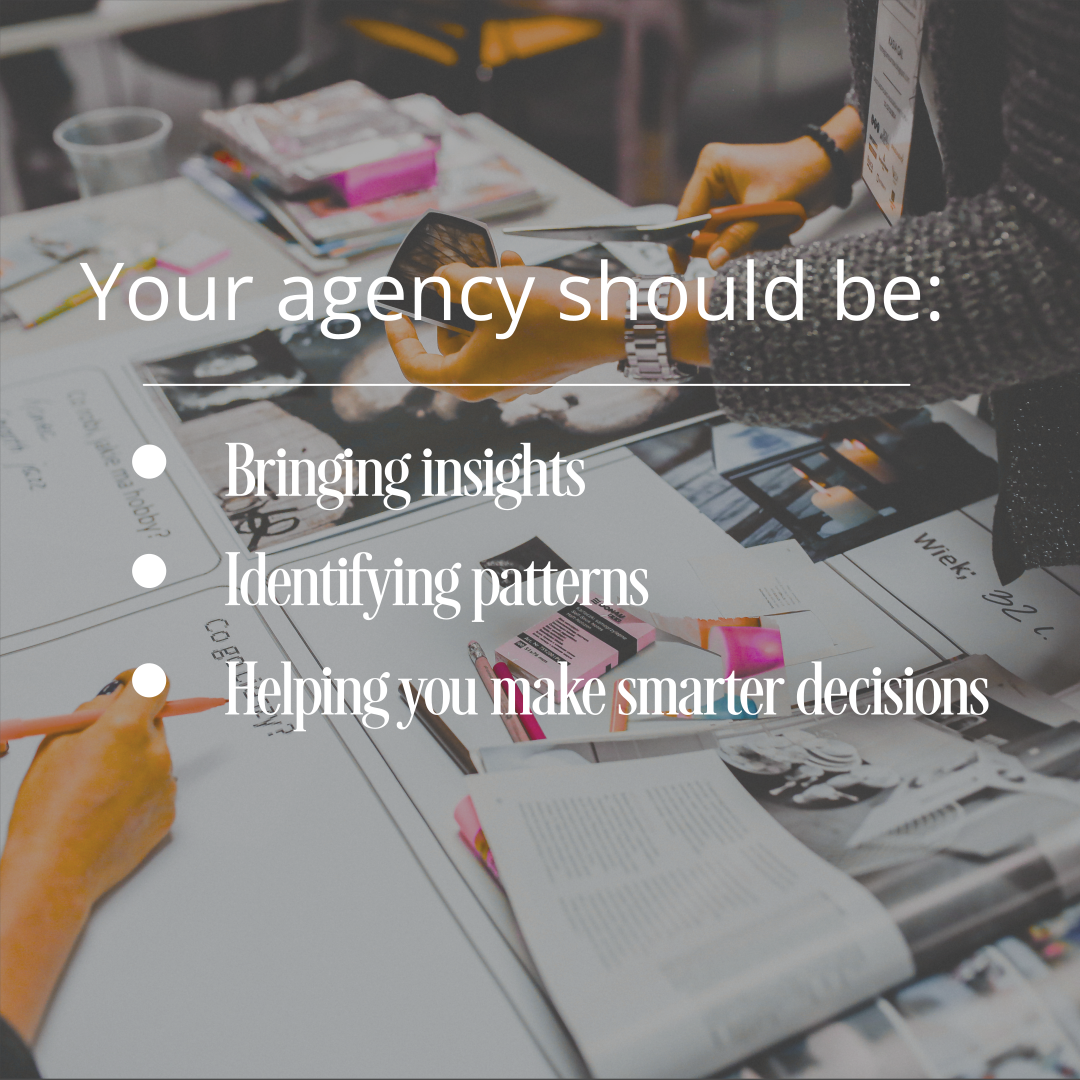
Your industrial manufacturing agency should be bringing insights, identifying patterns and helping you make smarter decisions over time. But that only works if the loop is closed and if internal performance data, sales outcomes and real-world results are shared back into the process.
Because the true value of a partnership isn’t in any single campaign. It’s in how each effort informs the next.
The Bottom Line: Partnership Is a Multiplier
When an agency relationship is approached as a series of transactions, its impact will always be limited.
But when it’s built as a true partnership, something changes. The work gets sharper, the strategy gets stronger and the results compound.
A B2B agency, at its best, isn’t just an extension of your marketing team. It’s a multiplier of your ability to grow – helping you successfully enter new markets, differentiate your offering and move faster with greater confidence. But that only happens when the relationship evolves beyond tasks and timelines into something more intentional.
“At DeanHouston, we’ve built our model around that belief,” Schindler added. “Because in the end, the question isn’t whether you have an agency. It’s whether you’re getting everything you could out of the one you chose.”
If you’re ready to move beyond vendor relationships and build a marketing engine designed for growth, let’s start a conversation.