
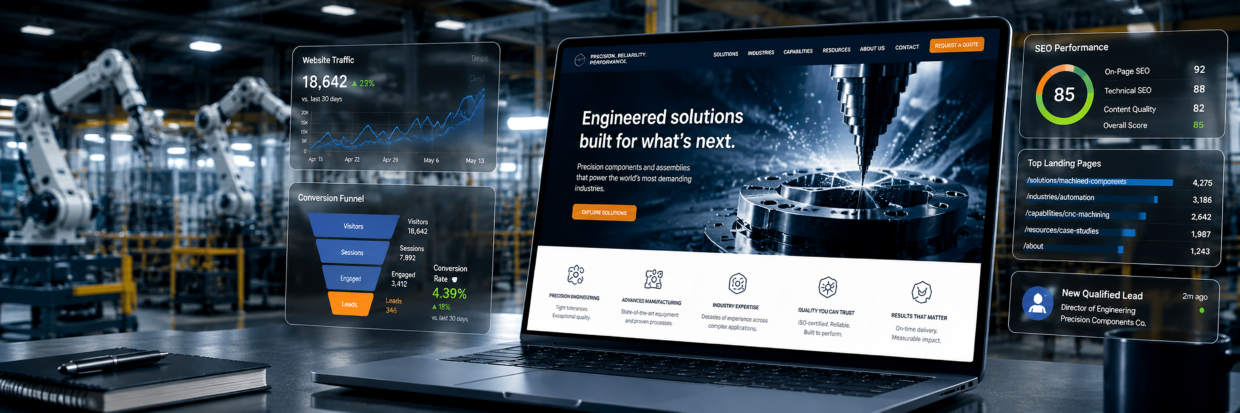
If your website is driving plenty of traffic but your sales team is still searching for high-quality leads, you’re not alone.
For industrial manufacturers, a website should do far more than showcase products or reinforce credibility. It should actively support business growth by attracting the right buyers, educating them and helping move them closer to a conversation with your sales team.
Yet for many B2B manufacturers, a website has become little more than a digital brochure. It looks professional, checks all the boxes, and it may even receive respectable traffic. But it isn’t producing qualified opportunities.
So what’s going wrong?
The answer usually isn’t that your website is broken. It’s that it’s not aligned with how modern industrial buyers actually buy.
Industrial Buyers Have Changed
Today’s B2B buying journey begins long before someone fills out a contact form. Engineers are reviewing specifications, procurement teams are comparing suppliers, operations leaders are seeking evidence that you understand their challenges, and executives are evaluating risk before they ever engage with your sales team.
In many cases, buyers are already 70% or more of the way through their decision-making process before they ever speak with a salesperson. By then, your website has already shaped their perception of your company – whether you realize it or not.
If your site simply lists products, capabilities and company history, you’re asking visitors to do all the work. Instead, your website should answer questions, reduce uncertainty and build confidence at every stage of the buying journey.
 Better Traffic Is The Goal
One of the biggest misconceptions in industrial marketing is that success equals more website visitors. Not necessarily.
Ten visitors actively researching an automation upgrade are infinitely more valuable than 1,000 people who accidentally found your website while searching for something unrelated.
Qualified lead generation starts by attracting the right audience. That means your website content needs to align with the problems your ideal customers are trying to solve, not simply the products you manufacture.
The difference seems subtle, but it’s actually enormous.
Your Website Might Be Talking About You Too Much
Take a critical look at your homepage. How many headlines begin with “We,” “Our,” or “For over 50 years”? While these statements certainly have their place, they shouldn’t be the main focus of your messaging.
But buyers arrive with a different question: Can you solve my problem?
The strongest manufacturing websites quickly demonstrate an understanding of customer challenges before explaining how the company solves them.
When your messaging shifts from talking about yourself to helping your audience, engagement almost always improves.
Slow Websites Lose Fast Buyers
Industrial buyers may be patient with long sales cycles. They are not patient with slow websites. Every extra second of load time increases the likelihood that visitors abandon your site before engaging with your content.
Performance isn’t just about user experience. Search engines increasingly reward websites that deliver fast, stable and accessible experiences across desktop and mobile devices.
Speed affects SEO, conversions and how buyers perceive your professionalism.
Your Content Answers Questions. Or It Creates More Questions.
Many industrial manufacturing websites unintentionally create friction because they assume visitors already understand technical terminology, product categories or internal processes.
Your buyers may be technical, but that doesn’t mean they know your company.
Effective industrial content anticipates the questions buyers ask throughout the research process. Examples include:
- How does this product compare to alternatives?
- What industries does it work best in?
- How long does implementation take?
- What ROI should we expect?
- What certifications are required?
- What problems does this actually solve?
When your website provides those answers before prospects ask, trust accelerates.
This is also where Answer Engine Optimization (AEO) becomes increasingly important. Search engines and AI-powered search experiences prioritize content that directly answers real customer questions.
If your website consistently provides those answers, you’re far more likely to become the trusted resource buyers discover first.
Calls-to-Action Should Match Buying Intent
Not every visitor is ready to request a quote. And that’s okay.
One of the biggest lead-generation mistakes manufacturers make is assuming every visitor wants to “Contact Sales.” Most don’t, at least not yet.
Instead, give buyers multiple paths forward. Offer technical guides, provide application resources, share case studies, invite them to subscribe for industry insights and offer consultations when appropriate.
Every interaction should help move visitors one step closer to becoming qualified opportunities.
Your Website Is Never Finished
Many manufacturing companies redesign their website every five to seven years. Then they leave it alone. Unfortunately, buyers don’t stop evolving during those seven years. Neither do search engines. Nor does your business.
The highest-performing industrial websites are continuously improved through analytics, user behavior, SEO performance and conversion testing.
The Best Manufacturing Websites Build Trust Before Sales Ever Gets Involved
 Marketing wants more leads. Sales wants better ones. A well-designed manufacturing website can deliver both – attracting the right visitors, educating them, removing friction and building the confidence they need to take action.
And by the time someone contacts your team, they’re already more informed, more qualified and more prepared to have a productive conversation. That’s not just good web design; it’s just good business.
Ready to Turn Your Website Into a Competitive Advantage?
If your website isn’t attracting the right buyers or converting them into qualified opportunities, it’s time for a different approach.
At DeanHouston, we help industrial manufacturers build digital experiences that generate measurable business results, not just website traffic. Let’s talk about how your website can become one of your hardest-working sales and marketing tools.
Connect with the DeanHouston team to schedule a website performance assessment.
Website Performance Frequently Asked Questions
Why isn’t my manufacturing website generating qualified leads?
Most manufacturing websites focus on products instead of customer problems. Qualified leads are generated when your website answers buyer questions, demonstrates expertise, provides valuable resources and makes it easy for prospects to take the next logical step.
How can manufacturers improve website lead generation?
Start by understanding your buyers’ decision-making process. Improve page speed, create educational content, optimize for SEO and Answer Engine Optimization (AEO), add relevant calls-to-action and continuously analyze visitor behavior to improve conversions.
What makes an industrial website effective?
The best industrial websites combine technical credibility with user-focused design. They clearly communicate value, answer complex questions, showcase real-world applications and make it easy for buyers to find the information they need.
Does website speed really affect lead generation?
Absolutely. Faster websites improve user experience, increase search visibility and reduce visitor abandonment. Even small improvements in page performance can have a measurable impact on conversions.
How often should manufacturers update their website?
Your website should evolve continuously. Review analytics monthly, update content regularly, publish fresh insights, improve SEO performance and refine user experience based on how buyers interact with your site. A website should be treated as an ongoing growth platform and not a one-time project.