

There has never been more content in the world, and there has never been an easier time to make more of it.
Give an AI platform a few prompts and, within minutes, you can have a blog post explaining why your product is innovative, a dozen social posts about your commitment to customers, an email campaign promoting your expertise, or a white paper positioning your company as an industry leader.
The words aren’t the hard part anymore. Believing them is.
That’s the challenge many B2B brands are beginning to face. As producing polished marketing content becomes faster and easier, buyers have more of it competing for their attention — and more reason to question what they’re reading.
So perhaps the most valuable content you can create today isn’t another piece about what you think makes your company great. It’s a story about what happened when a customer actually put your product to work.
Your Customers Can Say Things You Can’t

Every company says its products are reliable and that their company cares about quality, has outstanding service and solves difficult customer problems. Maybe all of those things are true. But there’s an enormous difference between a manufacturer telling a prospect, “Our equipment improves productivity,” and a customer saying, “We installed this equipment and increased throughput by 22%.”
One is a marketing claim while the other is evidence. That distinction is becoming increasingly important.
In our 2026 Sales + Marketing Trend Report, 60% of industrial marketers reported incorporating AI into their content-generation workflows, but few are satisfied with the quality of the output. Research also suggests that, among manufacturing marketers specifically, case studies and customer stories appear to be second only to video in reported effectiveness.
There’s a reason for that. A good case study doesn’t ask your audience to take your word for it — it gives them someone else’s.
The Best Case Studies Aren’t Really About You
This is where industrial manufacturing companies sometimes get case studies wrong. They approach them as extended product brochures.
The customer had a problem
↓
Our amazing product arrived
↓
Our amazing product solved everything
↓
Here’s a quote about how amazing we are
That’s technically a case study, but it just isn’t a particularly interesting one. The best customer stories have a protagonist, and it isn’t your company. It’s your customer.
- The plant manager who couldn’t afford another unplanned shutdown
- The engineer trying to solve a problem nobody else had been able to fix
- The operations team struggling to increase production without sacrificing safety
- The maintenance technician who’s happy because a company finally designed equipment with the user in mind
Those are stories people recognize, and when you tell them well, something interesting happens: your product becomes more meaningful because the audience sees it in the context of someone’s actual life and work.
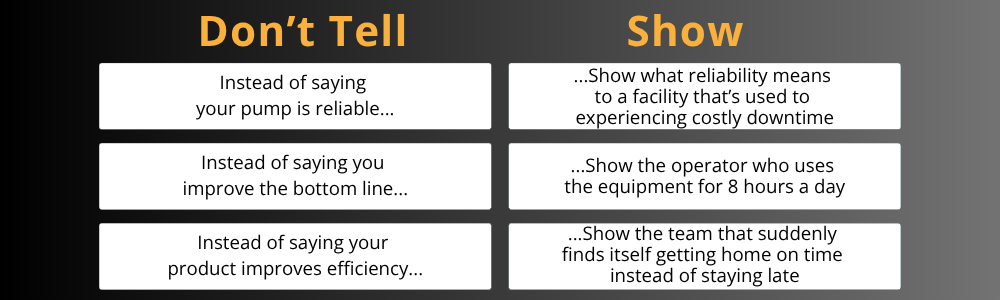
Now you’re not simply describing a product benefit; you’re showing why it matters.
Real People Are Becoming a Competitive Advantage
AI can summarize your product specifications, explain an application, and draft a respectable article about virtually any topic in your industry. What it cannot manufacture is a customer’s experience with your company. That belongs to you and your customer.
Case studies are difficult to fake because they’re specific, and specificity is what makes a story believable.
They have names, circumstances, frustrations, decisions and outcomes attached to them.
Over the years, we’ve seen evidence that putting people at the center of B2B storytelling can pay off. We have so many clients who shifted their approach from conventional product-focused case studies toward first-person stories. The resulting content helped contribute to substantial increases in website traffic and social engagement.
That’s a useful distinction. Because sometimes the best way to sell what you do is to stop selling long enough to let someone tell a story.
One Great Customer Story Can Go a Long Way
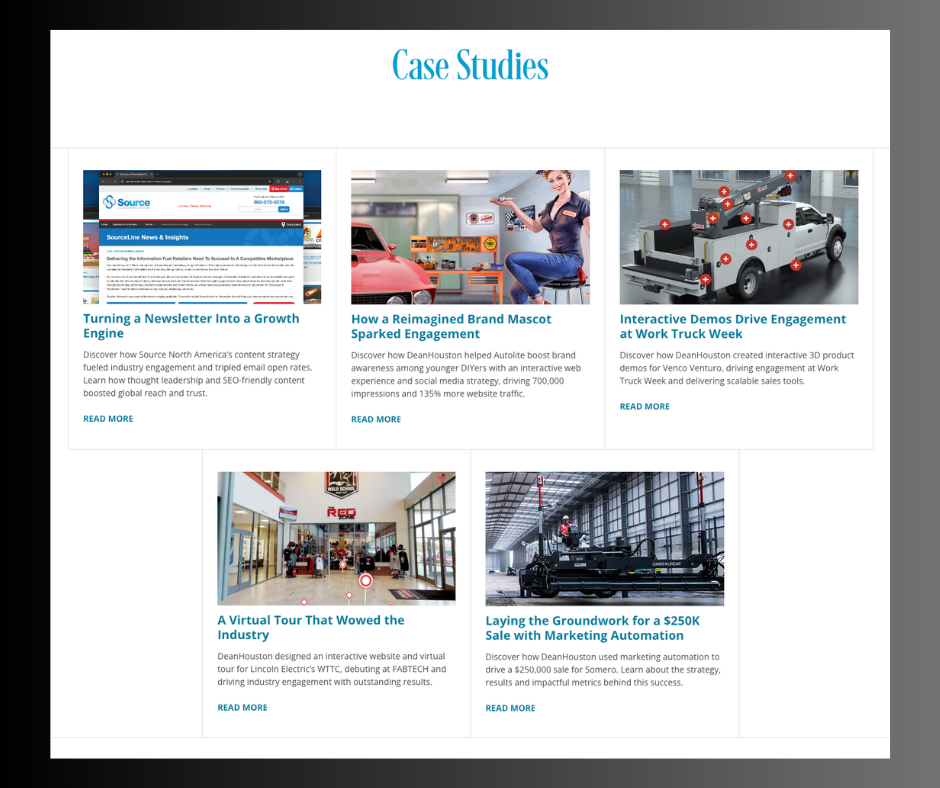 There’s another reason case studies deserve more attention: they shouldn’t be treated as one-and-done PDFs buried three clicks deep on your website. A strong customer interview can become the foundation for an entire collection of content.
- The full story can live on your website
- A compelling customer quote can become a social post
- A measurable result can lead an email campaign
- The customer’s challenge can become the opening of a sales presentation
- Video from the interview can become short clips for LinkedIn, trade shows and sales follow-ups
- The story itself can give your sales team something useful to send when a prospect says, “Have you ever solved a problem like ours?”
Suddenly, you’re not producing content simply to fill a calendar. You’re building a library of proof.
Show Them, Don’t Just Tell Them
Your company should absolutely have a point of view. Your engineers should share their expertise, leaders should talk about where the industry is headed, and marketing should explain what makes your products different.
But your customers can do something none of those things can. They can show what happens after the promises meet the real world. And in an era when producing another 800 words about your company’s capabilities takes less effort than ever, those real experiences become incredibly valuable.
Real companies. Real challenges. Real people. Real results.
Your competitors can make many of the same claims you make, and with the right prompt, they can even create content that sounds remarkably similar. But they can’t tell your customers’ stories. Those stories are yours. And they may be some of the most powerful marketing assets your brand has.
Your customers already have stories worth telling. DeanHouston can help you uncover them, shape them and turn them into case studies that give your brand something more powerful than a claim: proof. Let’s chat.