
For most industrial manufacturers, growth conversations tend to circle back to the same ideas: developing a new product line or adding a new feature to an existing product. It’s a logical idea since innovation is almost always a driver of progress. However, this approach is also expensive, time-consuming and uncertain.
What often gets overlooked is a simpler, more immediate path to growth. Taking what already works and applying it to a market with accelerating demand. The manufacturers gaining ground right now are thinking more strategically about where they sell while aligning their business to meet demand that’s already taking shape.
Because when you enter the right market at the right time, you’re not creating demand, you’re stepping into it.
Where Demand Is Moving
Not all markets offer the same opportunity, and not all growth is created equal. The most attractive markets share a few defining characteristics: sustained investment, infrastructure expansion and external pressure. This growth can be caused by new regulations, supply chain shifts, or technological changes. These forces create activity and an urgency that drives purchasing decisions.
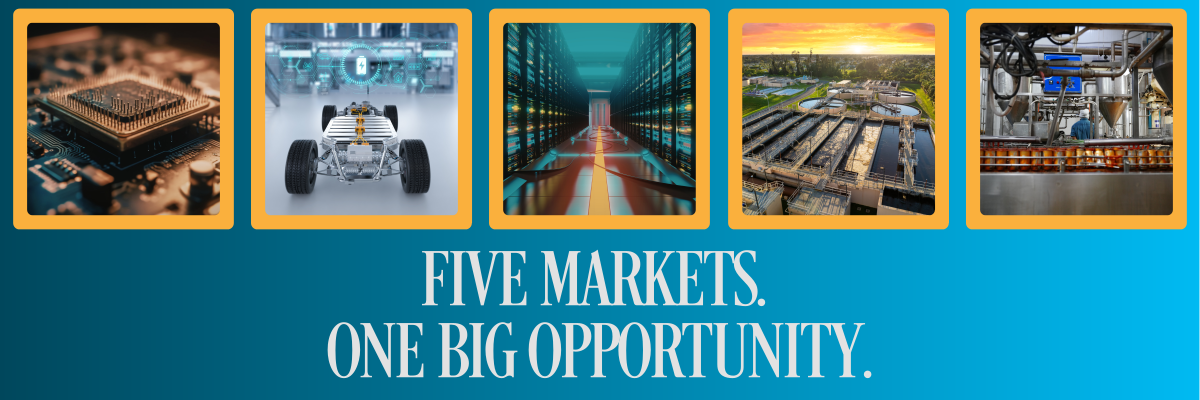
If you’re evaluating where to expand, these are five markets where those dynamics are converging in a meaningful way.

1. Semiconductor & Advanced Electronics Manufacturing
The push to reshore semiconductor production has fundamentally changed the landscape for advanced electronics manufacturing in the United States. What was once a globally distributed supply chain is being rebalanced through significant public and private investment.
For most technical product manufacturers, the opportunity isn’t in producing chips themselves, but in supporting the highly controlled environments where they’re made. These facilities depend on precision systems, ultra-clean components, and reliable infrastructure capable of meeting exacting standards.
Breaking into this market requires patience and credibility. Specifications are stringent, and relationships take time to establish. However, once a supplier is qualified, the long-term value can be substantial. This is a market where the barrier to entry is high, but so is the reward for those who meet the standard.

2. EV Battery & Energy Storage
Electrification has moved well beyond early adoption and into large-scale industrial buildout. Battery manufacturing facilities are expanding rapidly, and the supporting supply chain is evolving alongside them.
What makes this market compelling is that it is still being defined. Standards are emerging, partnerships are forming, and many parts of the ecosystem remain open to new entrants.
Manufacturers have an opportunity to contribute across multiple points in the process, from material handling and thermal management to safety systems and testing equipment. While OEMs often attract the most attention, some of the most accessible opportunities exist further down the supply chain, where suppliers need capable partners who can move quickly and adapt as the market matures.
3. Data Centers & AI Infrastructure

The rapid advancement of artificial intelligence has placed unprecedented demand on the physical infrastructure that supports it. Data centers are expanding in both scale and complexity, with increasing pressure on power availability, cooling efficiency and system reliability. That shift is creating new opportunities for manufacturers who can support the systems behind the surge.
For B2B manufacturers, this creates a clear and immediate need. Operators are looking for solutions that can help them manage heat, optimize energy use and maintain uptime in environments where even minor disruptions carry significant consequences. For manufacturers who can meet those demands, it opens the door to becoming a critical part of a rapidly expanding infrastructure.
This market rewards companies that can solve real operational challenges. It also favors those who can respond quickly, as timelines for new facilities continue to compress amid rising demand. For manufacturers who can keep up, that pace creates a meaningful competitive advantage.

4. Water & Wastewater Infrastructure
While less visible than some emerging sectors, water infrastructure represents one of the most stable and necessary areas of investment in the industrial economy. Aging systems, regulatory requirements and environmental concerns are driving consistent funding into both municipal and industrial projects.
For industrial manufacturers, this translates into ongoing demand for equipment and systems that support water movement, treatment and monitoring. The opportunity spans a wide range of applications, from pumps and valves to filtration technologies and control systems.
What sets this market apart is its resilience. Demand is not tied to short-term trends but to long-term necessity, making it a strategic option for companies looking to balance growth with stability.

5. Food Processing Automation & Packaging
The food industry is navigating a combination of pressures that are accelerating investment in automation. Labor shortages, increased demand for packaged goods, and heightened expectations around safety and traceability are all contributing to this shift.
Manufacturers that can support automation, improve efficiency, or enhance compliance are well-positioned to enter this space. Unlike more capital-intensive industries, food processing includes a broad range of mid-sized operators who are actively investing and often able to move quickly when they see value. This creates a practical entry point for manufacturers who may not yet have experience in the sector but have solutions that can translate effectively.
Why Market Expansion Often Falls Short
Despite the clear opportunity, many market expansion efforts fail to gain traction. The reason is rarely the product itself. More often, it’s the assumption that what worked in one market will translate directly into another.
Each industry operates within its own context. Buyers have different priorities, evaluate risk differently and define value in ways that are specific to their environment. When companies fail to account for those differences, their message misses the mark.
Entering a new market successfully requires more than presence. It requires alignment.
What It Takes to Enter
Effective market expansion starts with a clear understanding of how your offering fits within the target market. That means translating your value proposition into language and outcomes that resonate with that audience.
It also requires building credibility. In markets where you may not have an established track record, demonstrating relevance becomes critical. This can come through certifications, performance data, or adjacent experience that signals your ability to deliver.
Finally, companies need to consider how they go to market. The channels, content and sales approach that worked previously may not be effective in a new environment. Adapting your strategy to match how that market operates is often the difference between early traction and prolonged stagnation.
The Opportunity in Front of You
Growth doesn’t always require reinvention. In many cases, it requires a shift in perspective – seeing your existing capabilities through the lens of a different market.
Industrial product manufacturers that embrace this approach can unlock new revenue streams without the time and cost of developing entirely new offerings. More importantly, they position themselves to move with the market rather than trying to create it.
In a landscape where timing and alignment matter more than ever, that advantage is difficult to overstate.
Ready to Approach Market Expansion with Clarity?
At DeanHouston, we help manufacturers identify and enter new markets with a focused approach through our Attack-A-Market® program. It’s designed to bring structure to market selection, clarity to positioning and momentum to execution.
If expanding into a new market is part of your growth strategy in 2026, we invite you to watch our Attack-A-Market webinar to see how leading manufacturers are turning opportunity into measurable results.
Because entering a market is only the first step. Winning in it requires a plan.