

There should probably be a support group for companies that have recently implemented a Customer Relationship Management (CRM) system.
After months of meetings, migrations, integrations, field mapping, training and debates over who exactly should be allowed to change what, the system finally goes live.
Everyone celebrates. Sales has a new place to track opportunities, marketing has a database and leadership has dashboards. Someone has undoubtedly promised that this is the moment everything changes.
And then… nothing changes. Or, at least, not nearly as much as everyone expected.
That’s because implementing a CRM isn’t the end of a marketing transformation. It’s the infrastructure that makes one possible.
The real opportunity starts with what you do next.
You Built the Engine, Now Give It Something to Do
Think about everything your CRM can potentially tell you:
✓ Who your prospects are
✓ Where they came from
✓ What they’re interested in
✓ Which emails they’re consuming
✓ Which campaigns influenced them
✓ When they became an opportunity
✓ Whether they eventually became a customer
Pretty powerful stuff. But there’s one small catch: People have to actually get into the CRM first.
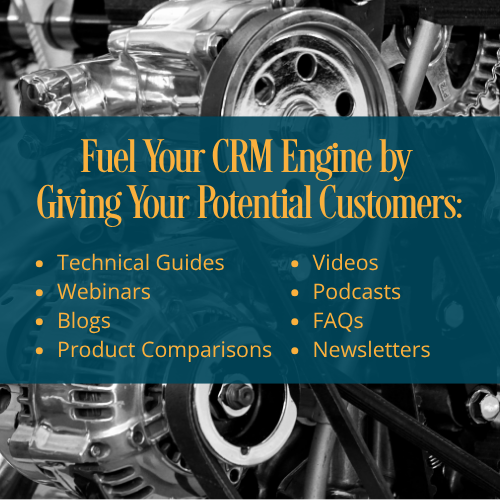 And that’s where marketing comes in.
A beautifully configured CRM with no strategy for generating demand is a little like building a six-lane highway without any entrance ramps. It’s impressive infrastructure. There’s just not much traffic.
Once the foundation is in place, the conversation needs to shift from “Is our CRM working?” to “What are we doing to make our CRM work for the business?”
That starts with creating demand.
First, Give People a Reason to Find You
Your next customer probably isn’t walking around the factory floor thinking: You know what I’d really enjoy today? Filling out a company’s contact form.
They’re trying to solve a problem.
Maybe they’re searching Google, reading an industry publication, comparing technologies, researching a new application, watching a video, clicking an ad, asking colleagues for recommendations, or quietly consuming six months of your content before anyone on your sales team knows they exist.
Your job is to be there.
- SEO helps them find you when they’re searching
- PPC and paid media put your company in front of the right audiences
- Blogs, videos, technical articles and thought leadership give them a reason to pay attention
- Social media keeps the brand visible
Integrated campaigns bring those pieces together around the markets, applications and opportunities that matter most to your business.
Suddenly, your CRM isn’t just sitting there waiting for someone to type in a contact. Marketing is feeding it.
Of course, getting 10,000 people to your website doesn’t mean much if 9,999 of them leave without doing anything.
Once you’re attracting the right audience, you need to give them a reason to take another step. That’s where landing pages, calls to action, forms and useful content start turning anonymous website traffic into actual people.
And once those people enter the CRM, things get much more interesting. Because now you can continue the conversation.
Not Ready to Buy? Perfect
This is where many B2B companies leave an enormous amount of opportunity on the table.
A prospect shows interest but isn’t ready to talk to sales. So nothing happens.
Maybe sales follows up once. Maybe the prospect gets added to a generic newsletter. Maybe everyone collectively hopes they’ll remember the company nine months from now when the capital budget gets approved.
Hope is not much of a nurture strategy.
Long B2B buying cycles make the CRM especially valuable because marketing doesn’t have to treat every interaction as buy now or goodbye forever.
Someone downloads a guide today
↓
They receive a relevant follow-up next week
↓
They see a case study addressing their application
↓
A month later, they attend a webinar
↓
Later, they return to the website and explore a specific product
Individually, those interactions may not mean much. Together, they start telling a story, and your CRM can help you see it.
Now Sales Has Something Better Than a Cold List
Here’s where marketing and sales should really start getting along.
The goal isn’t to dump more names into the CRM and proudly announce, “We generated 437 leads!” The goal is to help sales understand which people and companies are worth their attention.
- Who keeps coming back?
- Who is engaging with product content?
- Which accounts are responding to campaigns?
- Which prospects have moved from general education to highly specific research?
- Which existing customers are suddenly exploring another product line?
That’s when CRM data becomes more than a database. It becomes intelligence. And instead of calling someone because their name happens to be on a list, sales can start conversations with context.
That’s a very different interaction.
Then Comes the Question Everyone Actually Cares About
Is any of this working?
For years, marketers have gotten surprisingly good at reporting numbers that sound important.
✓ Impressions
✓ Clicks
✓ Sessions
✓ Opens
✓ Followers
✓ Downloads
Those numbers have value, but your CEO probably isn’t lying awake at night wondering whether last month’s click-through rate increased by 0.4%.
 The bigger questions are much more interesting.
- Which marketing activities are creating qualified opportunities?
- Which content is influencing buyers?
- Which campaigns are generating pipeline?
- Which markets are responding?
- Where are leads getting stuck?
- What should we invest more in?
- What should we stop doing?
- Is marketing helping grow the business?
When your CRM, website, campaigns and sales process are connected, you can start answering those questions with something better than a hunch. Then you use those answers to make the next campaign smarter. And the one after that smarter still.
The CRM Was Never the Destination
Buying the technology is relatively easy. Getting real value from it takes strategy.
It takes content people actually want, campaigns built around real business opportunities, paid and organic programs that bring the right audiences in, conversion experiences that encourage them to engage, nurture programs that keep the relationship moving, and measurement that tells you what is actually contributing to growth.
That’s when the CRM starts earning its keep. Not because it magically generates leads, but because you’ve built a marketing and sales ecosystem around it that can:
Attract → Capture → Nurture → Convert → Learn → Optimize
So, if your company recently finished implementing a CRM, congratulations. Celebrate the milestone and enjoy the new dashboards.
Then come back tomorrow and ask the question that really matters: Now that we have the engine, what are we going to do with it?
DeanHouston can help you build the strategy, content and campaigns that turn your marketing investment into measurable business growth. Let’s start a conversation.